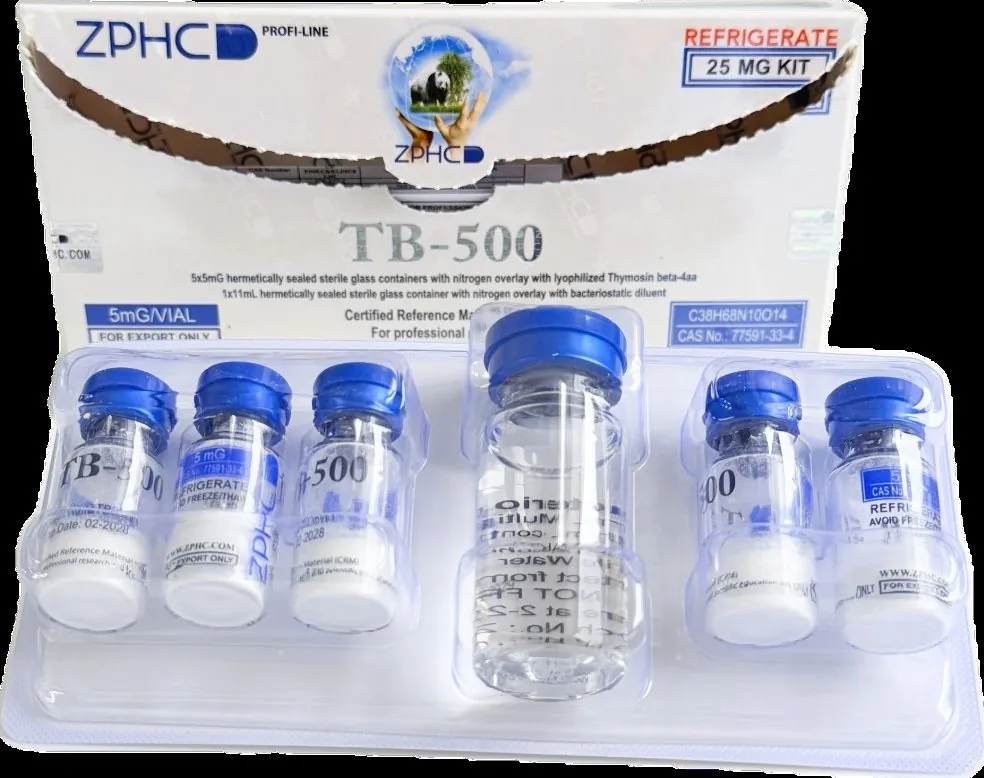
This article is about thymosin beta-4 — the natural protein that is most often the reason people buy a product labelled "TB-500": checks of labels and certificates of analysis show that, in most cases, this is what is actually in the vial sold under that trade name. The rest of the text refers to this protein — if you need information specifically about the short 7-amino-acid fragment that science formally calls TB-500, expand the box below.
So what is the substance actually called TB-500?
Strictly speaking, "TB-500" is a separate, much shorter substance: a synthetic fragment of 7 amino acids (Ac-LKKTETQ) cut from the middle of thymosin beta-4. This is the definition used by the FDA and by equine doping-control science.
- CAS: 885340-08-9
- Molecular weight: 889 g/mol
- First synthesised: 2003 (in non-acetylated form)
- First described in its current form: 2012–2013 (Ho et al. 2012; Esposito et al. 2013)
There are very few direct studies of this short substance itself, and they contradict each other: in one (2026, rats, Achilles tendon — Biçer et al.) it showed a positive effect; in another (2024, cell culture — Rahaman et al.) it showed no effect at all, apart from one of its metabolites. No official medical studies in humans have been found.
In sport its status is shared with thymosin beta-4: WADA explicitly lists TB-500 as a derivative of thymosin beta-4 (category S2.3). The FDA’s wording is narrower: Category 2 and the PCAC review refer specifically to the thymosin beta-4 fragment (LKKTETQ), known as TB-500, and the “Category 2 → removal → PCAC recommendation” path described applies to it. Full-length thymosin beta-4 is not FDA-approved either. Details are in the main article below.
What is it?
Class: natural protein, 43 amino acids; the main intracellular actin-binding protein.
CAS: 77591-33-4 · Formula/mass: C₂₁₂H₃₅₀N₅₆O₇₈S, ~4963.4 g/mol
Discovered: 1981 — isolated from calf thymus (Low, Hu, Goldstein).[4]
FDA status: not approved as a medicine — and unlikely to be "approved" in the next 5–10 years; the question is only whether pharmacies may compound it on prescription. Path: Category 2 (autumn 2023) → removed from Category 2 because the nominators withdrew their requests — this is not an approval and does not in itself create a legal basis for compounding (22 April 2026) → PCAC recommended adding it to the 503A Bulks List (23–24 July 2026, vote 8–6) — but this is only a recommendation; there is no final FDA decision yet.[1]
Status by country: no approved medicines in any country. In Australia — Schedule 4 since 2016.[2]
Status in sport (WADA): prohibited at all times, category S2.3.[3]
Thymosin beta-4 is a small protein present in high concentrations in platelets and in wound fluid in humans and animals. Its main studied function is binding monomeric G-actin: it regulates how much actin is available for polymerisation, and therefore cell shape, cell motility and intracellular transport.
Secondary effects linked to this basic function are the ones most often mentioned in connection with the substance: cell migration, angiogenesis (growth of new blood vessels, in particular via VEGF) and some anti-inflammatory pathways. No classical membrane receptor (like those for hormones) has been identified — its action works through intracellular protein interactions, primarily with actin.
When did it appear?
What is it used for?
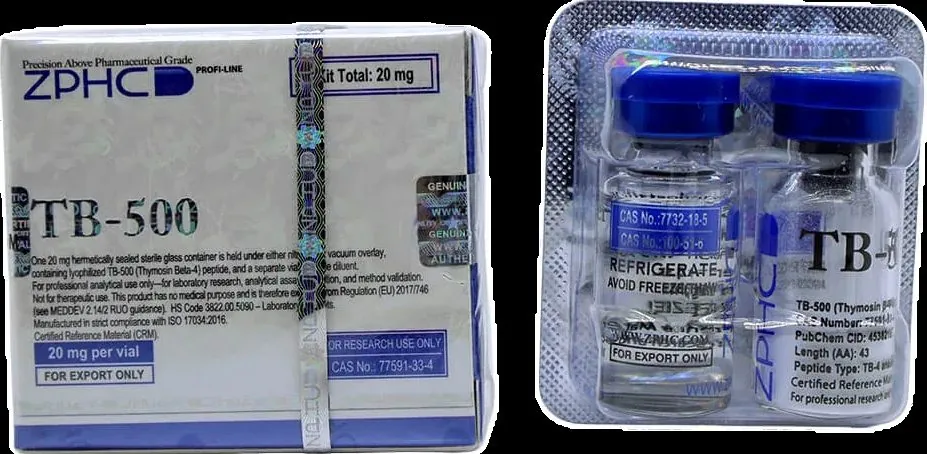
Close-up of the packaging and vials — the CAS number, batch marking and the note "Certified Reference Material" are visible. Image shown for information purposes only.
The stated purpose on the packaging we have seen (including ZPHC's) is invariably "for research purposes", "not for therapeutic use", "not for human use". The manufacturer nowhere claims a medical purpose. Meanwhile, sellers' websites carry the much broader list of promises shown above. But no official studies following an established methodology have been carried out in any of these areas, and these promises have not been confirmed by official medical organisations.
In sports and bodybuilding circles the substance is commonly combined with BPC-157 — the belief is that one peptide acts locally at the site of injury and the other systemically. There is no rigorous scientific basis for this division of roles — the idea took shape on forums, not in the laboratory.
A separate, well-documented area of use is veterinary: in horse racing the substance has been used (illegally under racing rules) to speed up horses' recovery from micro-injuries.
Expectations, popularity and doping in sport
These are two different questions. WADA does not ban a substance because someone has measured a competitive advantage: a ban applies if the substance meets at least two of three criteria — it has the potential to enhance performance, it poses a health risk, or it violates the "spirit of sport". Here the decisive criterion was the first one, and at the level of "has the potential to" rather than "has been proven to enhance": the ban itself reflects an assumed benefit for tissue recovery, not a measured effect on sporting performance.
Use in professional sport has been documented since at least 2011 — twice, both times in Australia.
Cronulla Sharks, rugby league (2011–2014)
Up to 14 of the club's players were suspected of receiving thymosin beta-4 and another peptide during the 2011 season. At the time of use the substance was not yet formally on the WADA list — this became a key argument for the defence. ASADA offered the players a deal: admit guilt and receive a 6-month suspension instead of a possible two years.[11]
Essendon, Australian football (2012–2016)
34 current and former players were accused of using the substance during the 2012 season. An important detail: there was never a positive doping test — the whole case was built on documents and witness testimony. In March 2015 the AFL Anti-Doping Tribunal found the evidence insufficient and cleared the players; only in 2016, after a WADA appeal, did the Court of Arbitration for Sport (CAS) find the 34 players guilty and suspend them for two years.[10]
Was an actual competitive advantage proven in these cases? No — neither in these cases nor in the scientific literature are there data that measured and confirmed that use gave the players a measurable advantage over those who did not use it. Both cases were about the fact of using a prohibited substance, not about any proven effect from it.
What has research shown?
In animals
- Skin wound healing — Malinda et al., J Invest Dermatol, 1999: in a full-thickness skin wound model in rats, it accelerated re-epithelialisation by 42% at day 4 and by 61% at day 7 compared with controls, and increased collagen deposition and angiogenesis.[5]
- Sepsis — Badamchian et al., Int Immunopharmacol, 2003: in mice given a lethal dose of endotoxin, Tβ4 administration significantly reduced mortality (p≤0.024) and blood levels of inflammatory cytokines.[13]
- Muscular dystrophy — Spurney et al., PLoS ONE, 2010: in a mouse model of Duchenne muscular dystrophy, chronic Tβ4 administration (150 µg twice a week for 6 months) significantly increased the number of regenerating muscle fibres compared with untreated animals.[14]
- Knee ligament (MCL) — Xu et al., Regulatory Peptides, 2013: more even organisation of collagen fibres when injected at the site of a ligament tear in rats.[6]
- Stroke — Morris et al., Neuroscience, 2010: improved neurological scores and increased density of blood vessels and myelinated axons.[7]
- Hair growth — Philp et al., FASEB J, 2004: stimulates hair follicle stem cells in mice.[8]
In humans
- RGN-259 (eye drops) — Phase II, corneal ulcers and dry eye syndrome; mixed results across different trials.
- RGN-137 (gel) — Phase II, epidermolysis bullosa, NCT00311766; terminated because of insufficient patient enrolment.
- RGN-352 (injections) — Phase I, tolerability confirmed; development for myocardial infarction was not completed.
- Two further independent safety trials. Ruff et al., Ann N Y Acad Sci, 2010 (sponsor RegeneRx, USA) — 40 healthy volunteers, intravenous, doses of 42–1260 mg, given as single doses and as repeated doses over 14 days; no dose-limiting adverse events. Wang et al., J Cell Mol Med, 2021 (China, recombinant Tβ4 NL005) — 84 healthy volunteers in total, also without serious adverse events. Both trials were about safety as such, not about efficacy for a specific injury.
- Lee & Padgett, 2021 (Altern Ther Health Med) — a retrospective analysis, combination with BPC-157 for knee pain: improvement in 3 of 4 patients. Small sample, no control group, no randomisation.[9]
What people who have used it say
We do not yet have a verifiable sample of real user reports large enough to honestly assess how often each type of experience occurs — assigning a frequency ("often", "rarely") without real data behind it would be dishonest. Below are only specific, checked examples with their sources; this section will be expanded as new accounts come in.
Trustpilot, 19 March 2026. A buyer from the UK (Kevin Bull) reports that he tore a muscle and tendon playing squash and had a long recovery; a BPC-157 and TB-500 blend from the seller Samual's Health was recommended to him — according to him, the result was good, and after two weeks the injury had fully healed. An important caveat: this is a review of a blend of two peptides, not of TB-500 alone, and the assessment of the effect is one person's personal observation, not a controlled study.
YouTube, a Russian-speaking fitness coach (not a doctor), "BPC-157 и TB-500 — работают или шляпа" (“BPC-157 and TB-500: do they work or is it hype?”, in Russian). A measured tone, no hype: he describes improvement in his knee and elbow over 4 months — gradual rather than immediate — and noticed no side effects himself; he also mentions an acquaintance with a 200 kg deadlift who also felt better. This is the personal experience of someone without medical training, not a clinical observation.
YouTube, Dr. Jeff Pang, a sports medicine physician, "What Science ACTUALLY Says About TB 500 Benefits". One of the most honest sources we found: the doctor himself says that results in his patients are mixed — some report faster recovery and less pain, others see no difference at all. He does not present wishful thinking as the norm and does not hide cases where there was no effect.
Trustpilot, January 2026. A buyer from Italy reports feeling no effect from an oral form of TB-500 and calls the purchase "a waste of money". He himself attributes this to the peptide supposedly being broken down in the stomach — but that is his personal guess, unsupported by anything: the cause could just as well have been that the substance has no effect as such, a counterfeit, or anything else. We include in this article only the observed fact (there was no effect), without the unverifiable theory about the cause.
A separate observation from watching dozens of YouTube videos found by searching "TB-500": content with positive reviews of use clearly predominates; in second place, by a wide margin, are warnings that the substance is under-studied — and most of these do not mention that TB-500 has been used in professional sport since at least 2011, and possibly earlier. We were unable to find reports of significant harm from use. It would be wrong to treat this as statistics: only a few dozen videos that happened to appear in the search results were viewed, not a representative or systematically collected sample.
What doctors usually say
Public statements by doctors about this substance almost always come down to the same points: it has not been studied in humans, its mechanism of action is unclear, and there is no guarantee of what is actually in the vial — this is how orthopaedic surgeon Dr. Victor Prisk (Prisk Orthopaedics and Wellness, Pittsburgh) puts it on his blog, adding that a doctor prescribing such a substance is legally close to medical malpractice. There is little point in analysing each such statement separately — they are predictably similar. It is a different matter when a doctor describes a specific observed effect in a specific patient rather than a general warning; we found two such cases — Dr. Jeff Pang's view on mixed results in his patients is given above, and a case from the practice of the East West Health clinic is in the "Individual clinical cases" section below.
Possible effects
- Healing of wounds and ligaments
- Stimulation of angiogenesis and cell migration
- Anti-inflammatory action
- Hair growth (preclinical data in rodents only)
- Cardio- and neuroprotection (strong preclinical data; clinical development not completed)
None of these has been confirmed by controlled human studies in the context of sports recovery.
Possible risks
The safety profile of regular injectable use in humans outside controlled clinical trials has not been studied.
Immunogenicity and aggregation — a theoretical risk for any injectable peptide, especially without pharmaceutical control of impurities.
The theoretical risk associated with angiogenesis is speculative — it has neither been specifically confirmed nor refuted; no observed cases in humans have been recorded.
No data on long-term use.
Prohibited by WADA at all times (category S2.3) — legal and career risks for athletes.[3]
Grey-market risks — products outside the pharmacy system, with no control of endotoxins or foreign impurities.
Even peptides that have completed full clinical trials and are sold as medicines have side effects related specifically to injections. For example, for tirzepatide (Mounjaro, Zepbound), according to the FDA label:[19][20][21]
- injection-site reactions (redness, itching, induration): 3.2% vs 0.4% on placebo;
- allergic reactions: 3.2% vs 1.7% on placebo; rare cases of anaphylaxis and angioedema have been described after market launch;
- anti-drug antibodies: developed in 51% of trial participants. These participants had injection-site reactions and allergies more often.
For an approved medicine, these risks have been measured in thousands of people, and manufacturing is overseen by a regulator. No such data exist for TB-500, so the frequency of such reactions is unknown. On top of that come the risks of unlicensed manufacturing: contamination, errors in the amount of substance, lack of sterility. More on the tirzepatide page →
Contraindications / who should be especially cautious
- Active cancer — because of the theoretical risk associated with stimulating angiogenesis.
- Pregnancy and breastfeeding — there are no safety data.
- Children — there are no data.
- Athletes subject to doping control — the substance is permanently prohibited by WADA (S2.3).
- Residents of Australia — Schedule 4 since 2016; possession without a prescription is illegal.
- People with a history of allergic/immune reactions.
Individual clinical cases
Lee & Padgett, 2021 — 4 patients received the combination with BPC-157 for knee pain; 3 of 4 improved. Small sample, no control group; this cannot be considered evidence of efficacy.[9]
YouTube, East West Health clinic, "What Are The Potential Side Effects Of Using TB-500". A 47-year-old patient after rotator cuff surgery first had an immune reaction — presumably because of a poor-quality source of the peptide. After switching source and adding BPC-157 and growth hormone, he recovered ahead of schedule and regained full range of motion. An important caveat: the video was made by the clinic itself and promotes its services, so it should not be taken as an independent assessment — it is a review of a single case with an obvious commercial bias.[16]
The position of FDA staff before the PCAC vote (2026): human safety and efficacy data are insufficient for inclusion on the compounding list. The committee voted otherwise (8 to 6), but that does not change the absence of clinical data.[1]