What is it?
What it is: an experimental Eli Lilly drug for obesity and type 2 diabetes — a 39-amino-acid peptide that acts on three hormone receptors at once: GIP, GLP-1 and glucagon. Informal nicknames: “Triple G” and “GLP-3”.
Status: not approved anywhere; legally available only to participants in Lilly’s trials. The company plans to file with the FDA in the first quarter of 2027.[21]
When it appeared: first given to a human in March 2019; first scientific paper in 2022.[8][11] It is the youngest substance on this site: glutathione has been known since 1888, GHK-Cu since 1973, thymosin beta-4 (TB-500) since 1981 and BPC-157 since 1989–1993.
Sport: banned by WADA at all times as a substance not approved by any regulator (section S0).[6]
Retatrutide mimics three hormones that tell the body about food and regulate blood sugar:
- GLP-1 reduces appetite, slows stomach emptying and helps release insulin after meals. This is how semaglutide (Ozempic, Wegovy) works.
- GIP also boosts insulin release and affects fat metabolism. Together with GLP-1 it is used in tirzepatide (Mounjaro, Zepbound).
- Glucagon normally raises blood sugar, but it also increases energy expenditure and fat burning, especially in the liver. Approved drugs lack this component: the idea is that GLP-1 and GIP keep blood sugar in check while glucagon adds energy expenditure.
| Drug | Receptors | Status |
|---|---|---|
| Semaglutide | GLP-1 | approved (obesity, type 2 diabetes, etc.) |
| Tirzepatide | GIP + GLP-1 | approved (obesity, type 2 diabetes, etc.) |
| Retatrutide | GIP + GLP-1 + glucagon | under investigation, not approved |
Three receptors do not automatically mean “better” or “safer”: a head-to-head comparison with tirzepatide is still under way (see “What has research shown?”).
For those who want more detail: the structure of the molecule
Development code: LY3437943. It is a peptide based on the GIP sequence with non-standard amino acids (Aib, α-methylleucine) that protect it from breakdown by enzymes. A fatty acid (C20 diacid) is attached to one of the lysines: it binds the molecule to blood albumin, so the drug lasts about a week. Formula C₂₂₁H₃₄₂N₄₆O₆₈, mass ≈ 4731 g/mol; CAS 2381089-83-2; UNII NOP2Y096GV; DrugBank DB18993.[4][11]
When did it appear?
The name of the programme of final (phase 3) trials on which a regulator decides whether to approve the drug. Each number is a separate trial:
- TRIUMPH-1 — obesity without diabetes (with subgroups with knee osteoarthritis and sleep apnoea);
- TRIUMPH-2 — obesity and type 2 diabetes;
- TRIUMPH-3 — severe obesity and heart disease;
- TRIUMPH-4 — obesity and knee osteoarthritis;
- TRIUMPH-5 — comparison with tirzepatide (ongoing);
- TRIUMPH-Outcomes — heart attacks, strokes and kidney outcomes (ongoing).
A parallel programme, TRANSCEND-T2D, covers trials in type 2 diabetes, including a comparison with semaglutide.
Patents: why retatrutide is so fiercely contested
Patents. Lilly does not say which patents protect retatrutide. But a public database lists a Lilly patent family, “Incretin analogs”, with a priority date of 21 December 2017; the inventors include the first author of the scientific paper on retatrutide, and the peptide’s general formula matches its sequence (our own comparison). The US patent was granted in January 2023, with protection running, according to Google Patents’ estimate, until January 2039.[46][47] Chinese companies are already patenting their own methods of synthesising retatrutide.[48]
The dispute over “biologic” status. If the FDA classifies retatrutide as a protein (“biologic”) product, copies cannot appear for 12 years after approval; if as an ordinary drug, for 5 years. The FDA counts a chain of more than 40 alpha amino acids as a protein. Retatrutide’s main chain has 39 alpha amino acids, plus two more components in its “tail” (gamma-glutamate and ADO). By the FDA’s count it has at most 40 alpha amino acids, and ADO is not one of them; Lilly argues that all 41 should count. Lilly sued in 2024; in 2025 the court partly sided with both parties, and in September 2026 the case was heard on appeal, with no ruling yet.[49][50]
Why the stakes are high: according to the WHO, in 2022 2.5 billion adults were overweight and 890 million had obesity;[51] Lilly’s previous drug, tirzepatide, earned Lilly 36.5 billion dollars in 2025 and became the world’s best-selling drug;[52][53] and retatrutide itself has shown greater weight loss than approved counterparts at every stage of research. In August 2026 Lilly filed six lawsuits against sellers of “research peptides” — under consumer protection laws, not patent law.[54]
What is it used for?
Officially — only in trials: obesity, type 2 diabetes, knee osteoarthritis, sleep apnoea, chronic low back pain, kidney and liver disease, cardiovascular outcomes.[21] There are no approved indications.
Unofficially, “research” vials are bought for weight loss, for “cutting” in sport, or when tirzepatide and semaglutide have “stopped working”. Selling such products for human use is illegal:
Retatrutide has not been recognised as safe and effective and cannot be used even by pharmacies for compounding on prescription.[1] In 2026 the FDA warned a pharmacy that was repackaging retatrutide (quality violations were also found there)[2] and five online sellers. The FDA’s position: a “research use only” label changes nothing if the product is in effect sold to people.[3]
In 2025–2026 more than 14,000 doses of counterfeit “retatrutide” and “tirzepatide” pens were seized, including at an illegal workshop in Northampton.[27][28]
In July 2026 the sale of “Retatrutide” on online marketplaces disguised as “slimming” cosmetics was stopped; the agency reminded that injectable products must be registered as medicines.[7]
Retatrutide in trials vs a “research” vial
| In Lilly’s trials | “Research” vial (e.g. ZPHC) | |
|---|---|---|
| Manufacturer | Eli Lilly, to pharmaceutical standards | as stated on the packaging; the authenticity of ZPHC packaging can be checked by code |
| Who checks | regulators, ethics committees | only the manufacturer itself — a matter of trusting it |
| Contents | confirmed | as labelled; independent tests are almost non-existent, cases of substitution are isolated |
| Monitoring | doctors, lab tests, stopping if complications arise | none; “protocols” come from sellers and forums |
| Who gets it | people selected by strict criteria | anyone, including those who would be excluded from trials |
Why people buy the vials
There is no legal way to obtain retatrutide outside trials anywhere, and approval is not expected before 2027 at the earliest. Add the striking figures in the news, the price of approved counterparts (which are not always prescribed to people who are only slightly overweight) and the trend in fitness circles. The “research use” label makes it possible to sell without a prescription, although regulators consider this a violation. The price of this choice: quality has to be taken on trust, and there is no medical supervision.
What people expect from it and why it is popular
| Expectation | Where it comes from | What the data say |
|---|---|---|
| Lose more weight than on tirzepatide | press releases, media | no head-to-head comparison yet |
| “Burn fat while keeping muscle” | bodybuilding, bloggers | not proven: lean mass is lost too |
| Clear liver fat | 2024 study | shown on MRI; effect on cirrhosis not studied |
| Improve blood sugar, blood pressure, cholesterol | Lilly’s trials | blood sugar in diabetes — proven; blood pressure and lipids improve along with weight loss |
| “Speed up metabolism” | the role of glucagon | shown in animals; in humans — a hypothesis |
| Protect the heart | improvement in risk factors | not proven, a trial is ongoing |
Its popularity is fuelled by headlines running years ahead of approval, a habit of weekly injections formed by semaglutide and tirzepatide, and the nickname “GLP-3”, even though no such drug class officially exists.
What has research shown?
All the trials below are placebo-controlled, double-blind and sponsored by Lilly.
In animals
In obese mice, retatrutide reduced weight and fat more than drugs with one or two mechanisms, by increasing energy expenditure; it improved blood sugar and reduced liver fat. In monkeys and humans the heart rate rose and blood pressure fell.[11]
In humans: phase 2 (2023–2024)
- Obesity (338 people, 48 weeks): at the highest dose, 24.2% weight loss vs 2.1% on placebo, and weight was still falling. 6–16% dropped out because of side effects.[12]
- Type 2 diabetes (281 people, 36 weeks): glycated haemoglobin fell by about 2 percentage points, weight by up to ~17%.[13]
- Fatty liver disease (98 people, 24 weeks): at the highest doses, liver fat fell by more than 80%, to normal levels in most participants. This is an MRI measure, not proven protection against cirrhosis.[14]
In humans: phase 3
| Trial | Participants | Publication | Main result |
|---|---|---|---|
| TRIUMPH-1 | 2339, obesity without diabetes, 80 wks | NEJM, 29.09.2026 | weight −17.6 / −23.7 / −25.0% (low / middle / high dose) vs −3.9%; less knee pain and fewer breathing pauses during sleep in the subgroups[15] |
| TRIUMPH-2 | 1152, obesity and type 2 diabetes, 80 wks | The Lancet, 29.09.2026 | weight up to −18.8% (up to −20.8% per the press release) vs −4.0%; glycated haemoglobin up to −1.6 percentage points[23] |
| TRIUMPH-3 | 1949, severe obesity and heart disease, 80 wks | press release | weight up to −22.6% vs −3.2%; the difference in heart attacks, strokes and deaths is not statistically significant[21] |
| TRIUMPH-4 | 445, obesity and knee osteoarthritis, 68 wks | press release | weight up to −28.7%; knee pain up to −75.8% (placebo — about −40%)[20] |
| TRANSCEND-T2D-1 | 537, type 2 diabetes, 40 wks | The Lancet, June 2026 | glycated haemoglobin up to −2.0 percentage points, weight up to −16.8% (press release)[22] |
What the trials have not yet shown
- superiority over tirzepatide and semaglutide — head-to-head trials (TRIUMPH-5, TRANSCEND-T2D-2) are not complete, and comparing figures from different trials is not valid;[10]
- long-term safety (beyond 2 years);
- a reduction in heart attacks, strokes and deaths — TRIUMPH-Outcomes is ongoing;
- what happens to weight after stopping (with drugs of this class it usually partly returns);
- preservation of muscle;
- safety in pregnancy and in children.
What people who have used it say
Personal experience is not proof. Almost all the authors used “research” vials, chose their doses themselves and often changed their diet or took other substances at the same time. Reddit posts were checked manually; videos were chosen at random (except obviously promotional ones). Doses and regimens are not given.
One year, woman aged 46: gradually lost about a sixth of her body weight; she says her blood sugar, blood pressure and cholesterol returned to normal. In parallel — hormone therapy for perimenopause.[29]
Two weeks: lost 3 kg, “I don’t feel hungry”; the side effect was constipation. Too short a period to draw conclusions.[30]
Three weeks, video blogger aged 26: lost 4 kg “effortlessly”, slight lethargy. Injects GHK-Cu at the same time; says himself that diet is what matters most and the drug merely quietens the “food noise”.[38]
Five weeks: lost 7.5 kg, but appetite “completely gone”, and in week four — nausea that got in the way of training. Admits to increasing the dose too quickly.[31]
Five months: body fat from 20 to 8%; severe diarrhoea in the first days. At the same time — testosterone, growth hormone and several peptides, so it is impossible to tell what worked.[32]
Man aged 24: lost 11 kg, but 5–6 hours of sleep, palpitations when falling asleep, almost no appetite, diarrhoea; thinking of stopping.[33]
Man aged 40: lost 15 kg in 10 months; most test results improved, but pancreatic enzymes are above normal and rising, although there are no symptoms. This is a reason to see a doctor.[36]
Man aged 63, video blogger: happy with his figure, but complains of skin sensitivity and bouts of weakness during workouts that forced him to rework his diet.[39]
Fitness blogger: reached his goal, but on a second course noticeably lost muscle, and disputes the “no muscle loss” myth. In the same video he repeats unverified claims about treating Alzheimer’s disease and cancer.[40]
Bodybuilder: after the first injection — chest pain, nausea, heartburn, arrhythmia; stopped.[34]
Painful skin: after a dose increase — sensitivity and tenderness of the skin all over the body; this matches the dysaesthesia seen in Lilly’s trials.[35]
A clinical trial participant
A 60-year-old man with heart disease, a participant in a Lilly trial. His weight did not go down; on the plus side — less joint pain and fewer sugar cravings, better sleep; on the minus side — “brain fog” and worse memory at the high dose, which did not go away after it was reduced. He is leaning towards leaving the trial.
What doctors say in videos
The authors’ personal opinions. Advice on use and supplements is not reproduced.
About 18% stopped treatment at the highest dose vs 4% on placebo — noticeably more than in similar semaglutide and tirzepatide trials; dysaesthesia affected one in five. Across all participants the difference from tirzepatide is small. Conclusion: until full safety data are available, it is not a first choice over tirzepatide.
“Tissue doesn’t lie, but labels can”: vials have no external guarantee of purity, sterility or dose. His main concerns are a rapid heart rate, muscle loss and a reduced ability to feel pleasure.
Fatigue, poor sleep, digestive problems, dry mouth, cramps, joint pain, rapid heart rate, skin tenderness. When to see a doctor immediately: an irregular heartbeat, chest pain, severe pain under the right ribs or abdominal pain radiating to the back.
Considers the effect on the liver, joints and blood lipids to be the main thing: according to the 2024 study, at the highest dose the liver returned to normal in 86% of participants within 24 weeks and in 93% within 48.
Most people lost weight and are happy with the result, but for many this came with side effects — from nausea to insomnia, palpitations, painful skin and changes in test results. Several people independently report muscle loss. Doctors differ in their assessments but agree that the drug is not approved and that “research” vials carry a separate risk.
Possible effects
Possible risks
Observed in Lilly’s trials
- Stomach and gut — the most common, dose-dependent: in TRIUMPH-1 at the highest dose, nausea in 42.4% (placebo: 14.8%), vomiting in 25.3% (4.8%).[24]
- Stopping treatment because of side effects — from ~4 to ~18% vs ~4–5% on placebo; in TRIUMPH-4 some people with lower body weight dropped out because they lost too much weight.[20]
- Dysaesthesia — tingling, burning, skin that hurts to the touch. Specific to retatrutide: 7% in phase 2, up to 21% in phase 3 vs ~1% on placebo; usually mild.[12][25]
- Increased heart rate, peaking around week 24.[12]
- Urinary tract infections (TRIUMPH-2), isolated cases of pancreatitis and cholecystitis in phase 2 — a link has not been established for all of them.
Users and doctors in videos add insomnia, dry mouth, cramps, joint pain and muscle loss (see “What people who have used it say”) — these are not among the common side effects in Lilly’s trials.
By analogy with similar drugs
- pancreatitis and gallstones, especially with rapid weight loss;
- thyroid tumours in rodents (the risk in humans is not proven, but approved counterparts are contraindicated with a family history of medullary thyroid cancer);
- dehydration from vomiting and diarrhoea; low blood sugar when combined with insulin.
“Research” vials
- Only the manufacturer confirms the contents. Confirmed cases of substance substitution are extremely rare — one is known (Australia, see “Individual clinical cases”); whether this is because it is rare or because few checks are done is impossible to say.
- The dose may differ from the label: ABC journalists working with the University of Queensland found more substance in the vials than stated.[26]
- No external guarantee of sterility — the FDA found excess endotoxins even at a pharmacy.[2]
- No doctor at hand — and in trials it is precisely supervision that makes treatment relatively safe.
Contraindications / who should be especially cautious
An unapproved drug has no prescribing information. Below are the people excluded from trials and those for whom similar drugs are contraindicated.
- Pregnancy, planning a pregnancy, breastfeeding; children and adolescents.
- Family history of medullary thyroid cancer or MEN 2 syndrome; past pancreatitis.
- Type 1 diabetes — not studied; a severe case has been described.
- Severe gastrointestinal disease, diabetic retinopathy, insulin use — by analogy with the drug class.
- Low body weight and “cutting” — the trials were in people with obesity; those with lower weight dropped out more often because of excessive weight loss.
- Eating disorders — sharp appetite suppression can make them worse.
- Heart rhythm disorders — the drug increases heart rate.
- Athletes — banned by WADA.
Individual clinical cases
We could not find a published case. The closest is TRIUMPH-4: knee pain disappeared completely in about one in eight people on retatrutide vs one in twenty-four on placebo (additional analysis, press release only).[20]
All the negative cases involve products bought online, not Lilly’s drug.
After an injection of “retatrutide” — intractable vomiting and an oesophageal rupture. The regulator’s analysis: the vial contained no retatrutide, but semaglutide at roughly 8 times the usual amount.[26]
A man with type 1 diabetes: vomiting, diarrhoea, ketones, acute kidney injury. A gut infection was found at the same time, so the drug’s contribution is hard to assess.[16]
Intractable diarrhoea and acute kidney injury after self-injection; improvement after IV fluids.[17]
A BMJ analysis: a link between the death and retatrutide has not been established; the situation is more complex than the headlines suggest.[18]
ZPHC products: what we could verify
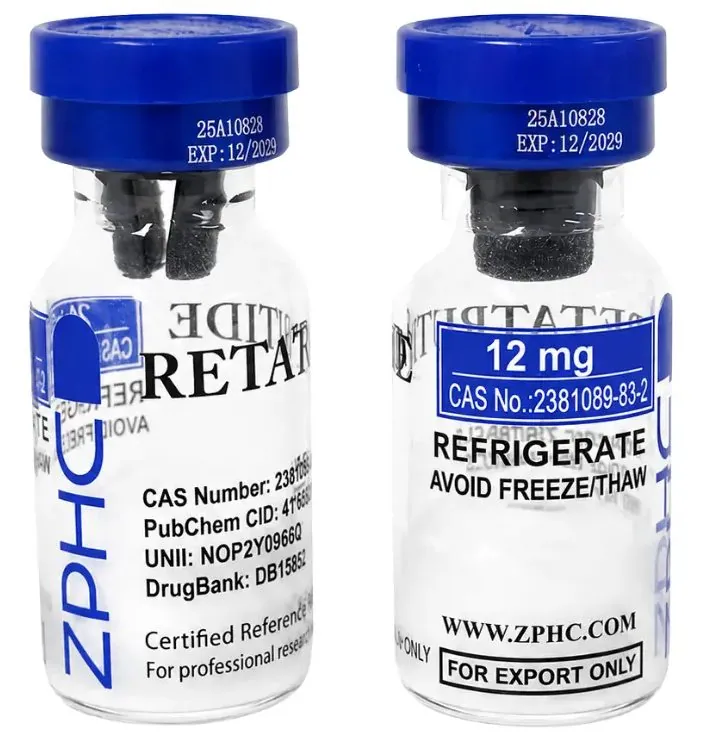
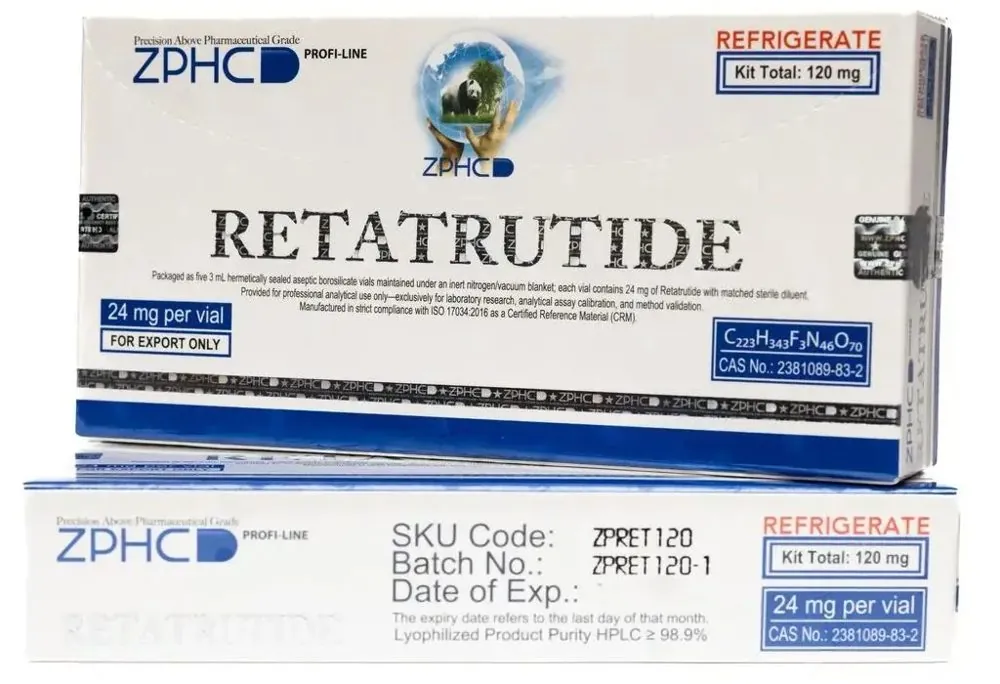
ZPHC Retatrutide vials. Photo from open sources. The manufacturer is mentioned as an example, with no partnership.
Kits of five vials of powder, some with a solvent. CAS 2381089-83-2 matches retatrutide. “Certified reference material”, “for analytical use only”, “for export only”, purity ≥ 98.9%.
Using the unique code on the packaging, you can confirm on the ZPHC website (validation.zphc.com) that the vial was made by ZPHC and is not a counterfeit of the brand. This protects against fakes but does not replace testing of the contents.
“Weight control”, “improved metabolism”, “sterile formulation for injection” — these are sellers’ words, not what is printed on the packaging.
The formula on the box (C₂₂₃H₃₄₃F₃N₄₆O₇₀) is retatrutide as a trifluoroacetate salt, which is usual after laboratory synthesis. The FDA database lists the sodium salt, so the form may differ from the one studied.
The solvent does not contradict the “analytical” purpose: in the lab the substance is also dissolved. The discrepancy lies elsewhere — between the label on the box and the sellers’ promises (the FDA’s position is in “What is it used for?”).
Errors in the codes on the vial: UNII “NOP2Y0966Q” instead of NOP2Y096GV, DrugBank “DB15852” instead of DB18993. This does not prove a fake, but the labelling clearly was not checked.
No independent tests — quality is confirmed only by the manufacturer. And even retatrutide of the stated purity is not the same product that Lilly studied: a different manufacturer, possibly a different salt, no medical supervision.