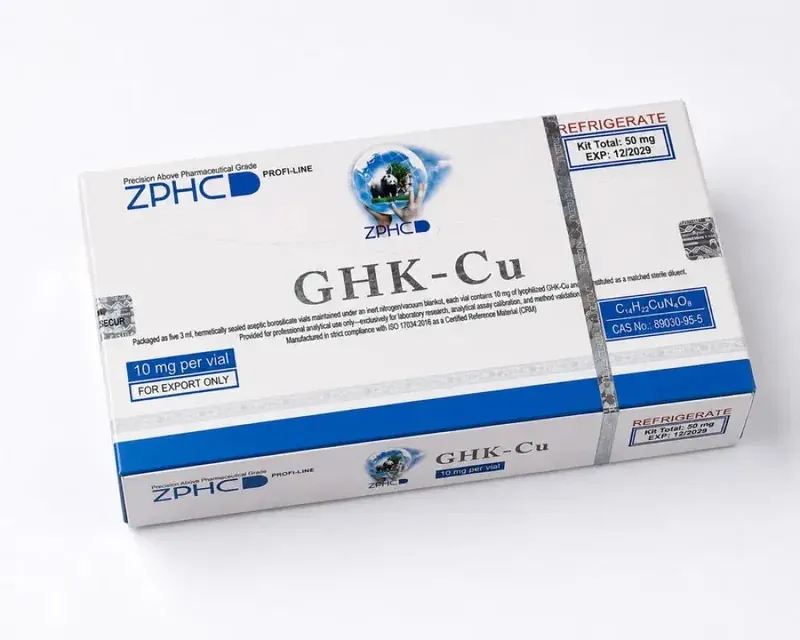
What is it?
GHK is a tripeptide made of three amino acids (glycine–histidine–lysine) that occurs naturally in human plasma, saliva and urine; according to some reviews, its concentration declines with age. GHK has a high affinity for the copper ion Cu²⁺ and forms a stable coordination complex with it — this is GHK-Cu.
Class: coordination complex of GHK with Cu²⁺; in cosmetics labelled as Copper Tripeptide-1.
CAS: GHK (without copper) — 49557-75-7; GHK-Cu (copper complex) — 89030-95-5.[6]
Formula / mass: GHK-Cu — C₁₄H₂₂CuN₆O₄, ≈403.9 g/mol; the GHK peptide itself — C₁₄H₂₄N₆O₄, 340.38 g/mol.[6]
Discovered: 1973, Loren Pickart.
Copper is an essential trace element and a cofactor for a number of enzymes: superoxide dismutase (antioxidant defence), lysyl oxidase (cross-linking and maturation of collagen and elastin) and others. So GHK-Cu cannot be regarded as "just a tripeptide" — the complex has its own coordination chemistry and, according to the hypothesis of several authors, may be involved in delivering copper to cells.
What is established and what is a hypothesis. Established: GHK is an endogenous human peptide; it forms a complex with Cu(II); in vitro, GHK-Cu stimulates fibroblasts to synthesise collagen and extracellular matrix components and modulates the activity of matrix metalloproteinases (MMPs) and their inhibitors (TIMPs). A hypothesis/interpretation put forward mainly by a single research group: that GHK-Cu "reprograms" the expression of thousands of genes and acts as a systemic tissue "regeneration switch". No classical membrane receptor (like those for hormones) has been identified.
When did it appear?
What is it used for?
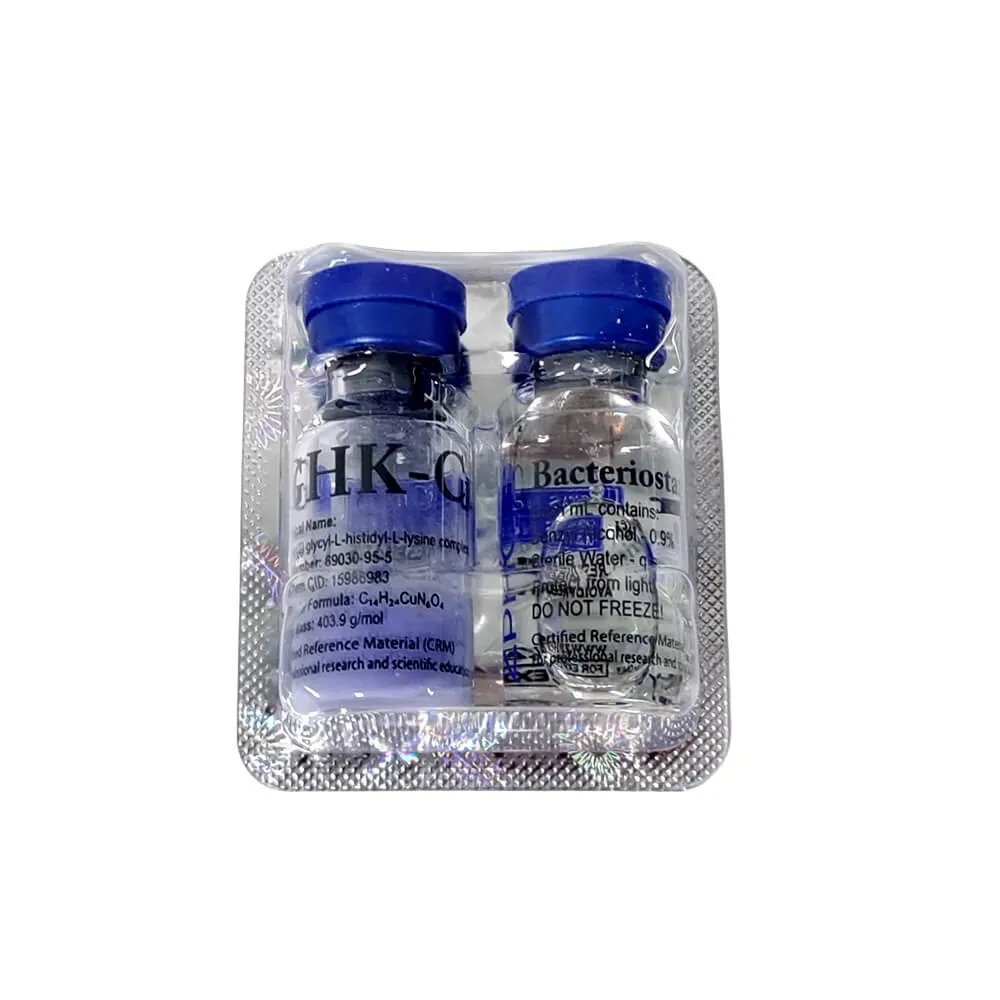
Close-up of GHK-Cu vials and sterile solvent — the CAS number, formula and the note "Certified Reference Material" are visible.
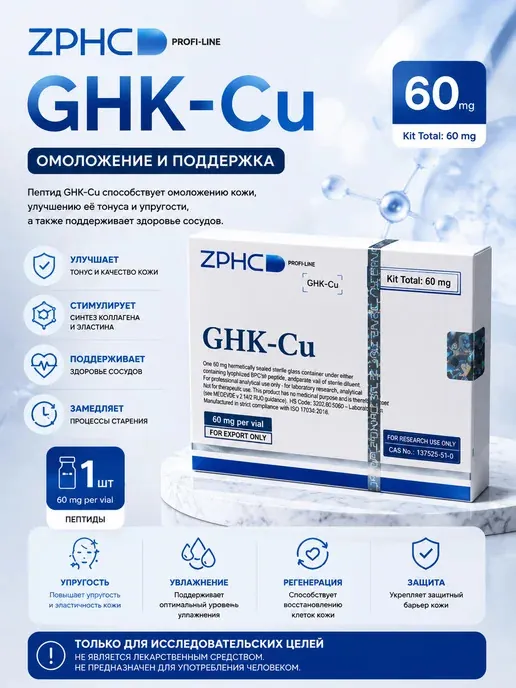
The same seller, a different packaging design — with promotional wording printed directly on the box (see the quote below).
The product is labelled as a "Certified Reference Material" — the manufacturer officially declares a research purpose, not a medical one. Source: our own photo of the packaging (for information purposes).
This is no longer restrained research labelling but direct promotional wording on the same seller's packaging — these claims have not been confirmed by clinical trials in humans. Source: our own photo of the packaging.
Cosmetics (topical use). The stated goal is to "improve the appearance" of the skin: fewer wrinkles, greater density and firmness, faster recovery after micro-damage and cosmetic procedures. This is the official industry position, registered as the function of a cosmetic ingredient in the European glossary; claims are limited to the "structure/function" framework (not treatment of disease).
Research preparations ("research chemicals"). Sold as a lyophilised powder labelled "not for human use" / "for laboratory research only". In reality, some buyers use the contents for self-administered injections — outside any regulatory oversight.
The difference is fundamental. Data on topical creams and data on injectable use concern different substances from an evidence point of view: bioavailability, metabolic pathway and risk profile differ, and one cannot be automatically extrapolated to the other. Below, the article keeps these two contexts explicitly separate.
What people expect from it and why it is popular
The most common expectations: fewer wrinkles and "rejuvenated" skin; faster healing of wounds, burns and scars; stimulation of hair growth and hair density; a general anti-inflammatory effect; and, among part of the audience, expectations of systemic "body rejuvenation", joint and ligament repair and sometimes even cognitive effects.
The sources of these expectations vary. Some are grounded in real biology: GHK-Cu really does affect fibroblasts, the extracellular matrix and a number of signalling pathways in vitro and in animal studies. Some rest on small, mostly old cosmetic studies that continue to be cited in marketing and review materials, even though some of these data go back to conference materials rather than modern independent randomised trials. Some expectations follow directly from wording in Pickart's reviews ("resets thousands of genes", "systemic rejuvenation"), which is an interpretation of laboratory data rather than established clinical effects. Finally, much of the expectation about injectable use spreads through social media and biohacking forums (Reddit, YouTube, Telegram), where individual user stories are presented as a confirmed effect even though causality has not been established.
What has research shown?
Animal studies
- Wound healing. In several studies in rats and mice, topical or local application of GHK-Cu accelerated closure of experimental wounds, increased type I and III collagen content and stimulated angiogenesis (in particular via VEGF).
- Matrix remodelling. Some studies showed modulation of MMP-2 expression and of the inhibitors TIMP-1/TIMP-2 in rodent wound models — an effect not only on the formation but also on the breakdown of the matrix.
- Anti-inflammatory effect in acute lung injury. A study in mice with LPS-induced lung injury showed reduced infiltration of inflammatory cells and lower levels of pro-inflammatory cytokines (TNF-α, IL-6) with GHK-Cu administration.
- Tendons. In a rat model of Achilles tendon injury, an increase in the strength of the healed tissue was reported.
The sources for this block are peer-reviewed publications, but the samples are small (usually 6–15 animals per group) and not blinded to modern standards — these are early, mainly preclinical data, not proof of an effect in humans.
Human studies
Here the evidence base is noticeably weaker than marketing often suggests, and every review we found acknowledges this.
- Wound healing (topical). Mulder G.D. et al., "Enhanced healing of ulcers in patients with diabetes by topical treatment with glycyl-L-histidyl-L-lysine copper", Wound Repair and Regeneration, 1994.[7] We were able to confirm the exact figures through a secondary source[8]: median ulcer closure — 98.5% vs 60.8% in controls (p < 0.05); infection rate — 7% vs 34% in controls (p < 0.05). The author of the secondary source is Pickart; see the conflict of interest above.
- Creams for photoageing. Two small studies are repeatedly cited in the review literature: a GHK-Cu cream in 71 women with photodamaged skin (12 weeks) and a study in 41 women in the periorbital area (compared with placebo/a vitamin K cream). Caveat: the primary material on these studies comes mainly from conference proceedings around 1990–2000 rather than from full-length modern independent publications.
- After CO₂ laser resurfacing. A small study (about 13 participants who completed it) showed no statistically significant advantage of GHK-Cu on objective assessments by blinded raters, while patients' subjective satisfaction was higher in the GHK-Cu group — a mixed result.
- A 2026 systematic review. Mokhtar J. et al., "The Regenerative Potential of GHK-Cu in Aesthetic Medicine", Aesthetic Surgery Journal, 20 August 2026: a search of PubMed/Embase/Cochrane CENTRAL up to March 2026 included 20 studies, of which 18 were preclinical and only 2 were RCTs. Conclusion: a small clinical base alongside a large volume of preclinical data.
- Hair growth. We could not find high-quality modern RCTs specifically on GHK-Cu (rather than the related AHK-Cu) for treating hair loss in humans.
- Injectable/systemic use in humans. No published controlled clinical studies of injectable or systemic GHK-Cu in humans were found — neither on efficacy nor on pharmacokinetics. This directly matches the FDA's position of "limited human data" for injectable forms.[1]
Other: in vitro, reviews, gene expression
- Fibroblasts and collagen. Work from the late 1980s and early 1990s showed stimulation of collagen and glycosaminoglycan synthesis in fibroblast cultures exposed to GHK-Cu, as well as modulation of MMP/TIMP.
- Keratinocytes. In a separate study on a cellular skin model, GHK-Cu showed no cytotoxicity and did not trigger significant irritation markers under the experimental conditions — but that is not the same as a lack of irritation in a real person using a finished cosmetic product.
- Gene expression (Connectivity Map). Pickart and co-authors reported that GHK/GHK-Cu is associated with changes in the expression of a substantial share of human genes in the Broad Institute Connectivity Map database (depending on the retelling, from several thousand genes to ~31% of ~54,000 analysed). This is bioinformatic/cellular work, not direct evidence of a clinical effect, and the authors of this line of research are linked to the commercialisation of the substance.
What people who have used it say
Users of topical forms most often report a more even skin tone, fewer fine lines, subjective improvement of old scars and faster recovery after dermarolling/peels. Users of injectable forms on biohacking forums and in videos report faster healing of ligaments and tendons, a subjective reduction in joint pain and faster recovery after training, as well as a visible acceleration of scalp hair growth (including as an unexpected side effect).
Reports of initial burning and discomfort at the application/injection site that decrease over time. The solution is kept in an acidic medium for stability, and contact with the neutral environment of the tissues irritates nerve endings; a local influx of copper may cause a short-lived inflammatory reaction.
The so-called "copper dump" / "GHK flu" effect — symptoms of mild copper toxicity (anxiety, "brain fog", insomnia, nausea). The "copper uglies" effect — temporary reddish patches and skin irritation with excessive/prolonged use, resolving within a few days to a few weeks. Separately — concern about the label not matching the actual contents, and thickening/coarsening of the skin at the sites of regular injections.
Note: these are anecdotal experiences from open sources, not clinical data. We could not find well-documented independent series of user reports that would allow the frequency of adverse reactions to be estimated.
Review of YouTube videos
We additionally reviewed eight English-language videos: practising doctors (including owners of clinics selling peptide protocols), a sceptical doctor-blogger who reviews the literature, and a biohacker blogger with a personal protocol. One video was excluded from the review — there GHK-Cu was taken together with other peptides, so the effects cannot be separated. The source level for all of them is 5 (personal opinion of a practising doctor) or 6 (anecdotal experience/blogger content).
The most substantive video: the topical data are solid; for injectable use there are zero published human clinical trials. He gives verifiable details — the copper-binding constant of GHK (log K ≈ 16.44) versus the binding site on albumin (≈16.2), a 2016 study in Scientific Reports on increased MMP-1 expression (a plausible mechanism for the "copper uglies"), keratinocyte data (no cytotoxicity up to 580 µM), a detailed FDA regulatory timeline, and preclinical anti-tumour data as a counterweight to the angiogenesis risk.
An advert for the clinic's consultations, but it mentions a detail not found in the other sources: the FDA is considering injectable GHK-Cu separately for COPD/emphysema therapy. Not independently verified. It repeats the "4,000+ genes / 30% of the genome" figure — this has appeared in 4+ independent sources already, but goes back to Pickart's work (conflict of interest, see above).
Both videos promote their own clinical protocols. Of substance: the practice of cycling (breaks in use) because of copper toxicity with long-term use; and the observation that GHK-Cu, as a reactive transition-metal complex, can reduce the stability of other peptides when mixed in the same vial (an argument against the popular "blends" of GHK-Cu + BPC-157 + TB-500 ± KPV).
Blogger content, but it independently confirms the "copper uglies" phenomenon, zinc–copper competition and degradation when several peptides are mixed in one vial — the same observations as the practising doctors, made independently of each other.
Essentially promotional content with unproven claims ("creates new hair follicle stem cells", "systemically protects the brain", citing unnamed "mouse studies"). Not usable as a source of facts, but a good illustration of the typical marketing tone in which the substance is presented to the audience.
For topical (cosmetic) use — a consistently positive picture, with the longest and calmest safety profile of anything reviewed here. For injectable use — mixed and uncertain: subjective reports are mostly positive or neutral, the mechanism of action is plausible and the preclinical toxicology looks reassuring, but there still is not a single controlled human study. This does not amount to proof that the injectable form is safe, but it does not support the alarmist extremes either — the real picture is closer to "probably reasonably well tolerated in practice, but formally unstudied".
Possible effects
Possible risks
Below, risks are divided into actually observed (regularly and independently reported by users/doctors against a background of long-term and fairly widespread use) and theoretical (cited by regulators and specialists as grounds for caution, but never encountered as a documented real case).
Actually observed
Local reactions at the application/injection site. Irritation, redness, burning — a consistently and long-documented effect for both cosmetic and injectable forms (burning at the injection site, short-lived redness for 24–48 hours).
The "copper uglies" effect. Temporary reddish patches and skin irritation (not literal "uglies"). With excessive or prolonged use, some users report a worsening rather than an improvement in how their skin looks; the effect is reversible and resolves within a few days to a few weeks. The most reproducible "mild" risk of injectable use.
Signs attributed to zinc deficiency with long-term/aggressive copper use — fatigue, weakened immunity, "brain fog". Copper and zinc compete for absorption — an established general fact of physiology — but a causal link to symptoms specifically with GHK-Cu use has not been documented.
Thickening/coarsening of the skin at the sites of regular injections with long courses — appears in independent user reports.
Quality and authenticity of products from the unregulated market. The most practically significant risk lies not in the molecule itself but in the supply chain. Standard mass-spectrometry analysis confirms the mass of the peptide but usually does not measure the proportion of free copper ions not bound in the complex — a "confirmed peptide" does not mean a "confirmed safe complex".
Theoretical
Immunogenicity, peptide aggregation, accumulation in tissues with injectable administration — the FDA's official position, based on the absence of data rather than on recorded cases: there is not a single published human pharmacokinetic study of GHK-Cu.[1]
Free copper as a pro-oxidant. Excess unbound copper is toxic; but preclinical work shows that copper bound in the complex with GHK does not show the cytotoxicity of free copper salts at the same concentration — the theoretical risk concerns mainly low-quality products in which the copper may not be fully bound.
Stimulation of angiogenesis — a useful property for wound healing, but one that theoretically calls for caution with active cancer. For balance: some preclinical studies show the opposite — activation of tumour suppressor genes and apoptosis in some tumour cell lines. There is no direct evidence in humans either way.
Risk in Wilson's disease and other disorders of copper metabolism — a logical theoretical contraindication; we found no documented real case of a complication in such a patient.
Even peptides that have completed full clinical trials and are sold as medicines have side effects related specifically to injections. For example, for tirzepatide (Mounjaro, Zepbound), according to the FDA label:[16][17][18]
- injection-site reactions (redness, itching, induration): 3.2% vs 0.4% on placebo;
- allergic reactions: 3.2% vs 1.7% on placebo; rare cases of anaphylaxis and angioedema have been described after market launch;
- anti-drug antibodies: developed in 51% of trial participants. These participants had injection-site reactions and allergies more often.
For an approved medicine, these risks have been measured in thousands of people, and manufacturing is overseen by a regulator. No such data exist for GHK-Cu, so the frequency of such reactions is unknown. On top of that come the risks of unlicensed manufacturing: contamination, errors in the amount of substance, lack of sterility. More on the tirzepatide page →
Contraindications / who should be especially cautious
There is no official, regulator-approved list of contraindications for GHK-Cu — because there is no approved medicinal product either. Below are areas of theoretical caution pointed out by several independent sources:
- Wilson's disease and other disorders of copper metabolism. In this condition the body cannot excrete copper normally, which leads to its pathological accumulation in the liver, brain, eyes and other organs. An additional copper load is a justified area of caution, although an official contraindication specifically for GHK-Cu cannot be confirmed.
- Pregnancy and breastfeeding. No high-quality safety data were found — the correct wording is "data are insufficient", not "proven to be contraindicated".
- Children. No high-quality clinical data on use in children were found.
- Active cancer. Because of the stimulation of angiogenesis — a theoretical, not a proven, area of caution.
- Copper/metal allergy — a risk of local skin reactions with topical use.
Individual clinical cases
We could not find a reliably identifiable and independently verifiable positive case of GHK-Cu use in a specific patient (a medical case report rather than a user review); the closest is the Mulder et al. 1994 study on diabetic ulcers,[7] but that is a group clinical study, not a single case.
We likewise could not find a reliably identifiable negative clinical case (for example, a documented case of a toxic reaction or severe allergy with an established causal link specifically to GHK-Cu) in verifiable medical sources.
ZPHC products: what we could verify
A packaging variant from the same seller with direct promotional wording — a real example of claims made "according to the manufacturer".
The manufacturer ZPHC is used on this site as an illustrative example, without any partnership. According to third-party (not ZPHC-owned) retail catalogues of "research peptides", the ZPHC range includes an item labelled GHK-Cu, as a lyophilised powder with a stated purity (from "≥98%" to "≥98.9%" by HPLC, depending on the source) and claims of GMP/ISO origin. All these figures are seller/manufacturer data, not independent verification.
The packaging (see the photos above and at the top of the article) states: CAS 89030-95-5 — which matches the verified number for GHK-Cu; a format of "10 mg/vial, 50 mg kit" or "60 mg/vial"; and the markings "FOR EXPORT ONLY" / "FOR RESEARCH USE ONLY" / "Not for therapeutic use". One packaging design is restrained, without promotional wording ("PROFI-LINE"); the other uses clearly marketing language directly on the box.
We could not find a publicly available, independently verifiable certificate of analysis (COA) specifically for ZPHC GHK-Cu that could be linked to a specific batch, laboratory and report number. One third-party database of laboratory tests is said to contain several entries for ZPHC products (mostly for other substances, not GHK-Cu) with an average measured purity of about 96% — but this is not a test of GHK-Cu specifically, and it would be wrong to use these figures as a "quality analysis of ZPHC GHK-Cu".